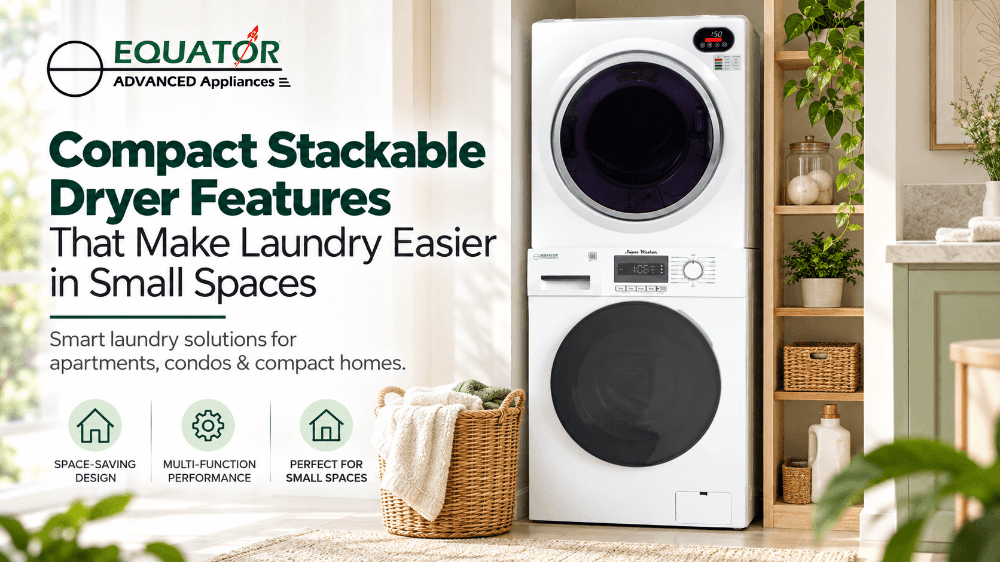
Why a Stackable Set Washer Dryer Works Well in Small Urban Homes
A compact stackable washer and dryer uses vertical space that might otherwise go unused. Instead of dedicating a wide section of a utility room to two appliances, stacking can concentrate the laundry footprint into one narrow area. This makes a Stackable Set Washer Dryer worth considering for apartment laundry closets, converted utility areas, RV interiors, accessory dwelling units, and smaller houses where every square foot has another job to do.
This arrangement can be particularly useful in neighborhoods dominated by apartments and attached housing. Think of the Upper West Side and Brooklyn's Park Slope in New York City, Back Bay in Boston, Lakeview in Chicago, San Francisco's Mission District, or Capitol Hill in Seattle. Homes around dense areas such as Central Park or Chicago's Loop often have very different floor plans from suburban houses with dedicated laundry rooms, so appliance dimensions and access requirements deserve careful attention.
Vertical design protects valuable floor space
The greatest advantage of stacked laundry machines is straightforward: the washer and dryer occupy approximately the floor area of one appliance when installed vertically. That can leave more room for shelving, storage bins, cleaning supplies, or simply easier movement through a compact home. Many sets can also be installed side-by-side when a future home provides more horizontal space, giving buyers additional flexibility.
Compact does not mean one-size-fits-all
A small stackable washing machine and dryer still needs enough clearance for hoses, connections, airflow, door movement, and safe stacking hardware. Measure the width, height, and depth of the entire installation area rather than measuring only the front opening of a closet. Also account for baseboards, trim, vent hoses, water connections, and the additional depth created when appliance doors are open.
Compact Stackable Dryer Features That Make Daily Laundry Easier
The best dryer features for a tight space are usually the ones that reduce manual work without adding installation complications. Capacity matters, but a dryer that automatically responds to moisture, offers useful fabric settings, provides accessible lint filtration, and fits the available infrastructure can be more practical than simply choosing the largest drum available.
Sensor drying helps prevent unnecessary drying time
Sensor drying is especially useful when laundry loads vary throughout the week. Instead of relying entirely on a fixed timer, compatible dryers can monitor moisture and adjust the drying process accordingly. This can help reduce unnecessary tumbling and makes it easier to handle mixed routines such as work clothes during the week, towels on weekends, or smaller frequent loads in an apartment.
The Equator compact stackable washer and dryer pairing combines the EW 822 1.57 cu. ft. washer with the ED 848 2.6 cu. ft. 110V dryer. Its compact configuration is suited to households whose priority is fitting separate laundry appliances into a restricted footprint rather than maximizing drum size.
Multiple dry cycles provide better fabric control
A compact dryer becomes more versatile when it offers several drying selections instead of forcing every load through the same cycle. Towels, everyday clothing, synthetics, and delicate garments do not always need identical heat or drying time. Having appropriate cycle choices can simplify daily laundry and help residents avoid repeatedly checking clothes manually.
Accessible lint filtration matters in tight closets
Lint filters are routine maintenance items, so accessibility should be part of the buying decision. A laundry closet may look large enough on paper but become awkward if a door, shelf, wall, or nearby cabinet blocks routine dryer maintenance. Before installation, picture how you will open the dryer, remove the lint filter, clean it, and reach connections without moving the complete stack.
Compact Laundry Challenges in New York, Chicago, Boston, San Francisco, and Seattle
Major U.S. cities share one important laundry challenge: housing was built across many eras, so appliance spaces and utility connections vary dramatically. An apartment in a newer Seattle building may have a purpose-built laundry closet, while a Boston brownstone conversion or older New York apartment may require much more careful planning. Chicago condos and San Francisco flats can introduce another variable: building or association rules governing appliance installation and exterior venting.
Three issues repeatedly deserve attention in compact urban installations. First, laundry closets can be shallow even when their width appears adequate. Second, dryer vent routes may be restricted by the location of exterior walls or existing ductwork. Third, electrical capacity and outlet configuration may differ from what buyers expect, particularly in older properties. These are reasons to verify the installation site before focusing on a discount stackable washer and dryer based on purchase price alone.
New York City apartments: measure doors and pathways
For apartments in Manhattan, Queens, or Brooklyn, the challenge may begin before installation. Hallways, elevators, staircases, apartment entrances, and closet openings all need to accommodate the appliance. Residents in prewar buildings or walk-ups should measure the complete delivery path, not just the intended laundry location.
Boston and Chicago: plan for older building layouts
Back Bay, the South End, Lakeview, and Lincoln Park include many homes where modern appliances have been fitted into structures originally designed for very different household equipment. Carefully inspect water connections, drainage, vent access, and outlet placement. Never assume that because an appliance physically fits, the existing utilities automatically support the installation.
San Francisco and Seattle: check building venting requirements
Anyone searching for a ventless stackable washer and dryer is often trying to solve one specific problem: there is no convenient route for an exterior dryer vent. That distinction is important with the products discussed here because these particular Equator dryer sets are vented configurations. If your Mission District condo, SoMa apartment, Belltown unit, or Capitol Hill rental prohibits new exterior penetrations, verify the approved drying system before purchasing a vented stackable set.
Comparing Compact Equator Stackable Laundry Options
Different households can have very different definitions of compact. A single resident may prioritize the smallest practical footprint, while a family in a small condo may accept a slightly larger machine for increased laundry capacity. Looking at several configurations helps clarify the trade-offs.
EW 822 with ED 848: ultra-compact everyday laundry
The Equator COMPACT STACKABLE LAUNDRY Washer EW 822 1.57cf + Dryer ED 848 2.6cf 110V is geared toward smaller laundry requirements and limited installation spaces. The combination can suit apartments, tiny homes, RV-style environments, or secondary laundry areas where a large conventional dryer would dominate the room. Its separate washer and dryer configuration also allows one load to be moved from washing to drying without relying on a single-drum all-in-one process.
EW 822 with ED 866: more dryer capacity in a compact configuration
Another option pairs the same EW 822 1.57 cu. ft. washer with a larger ED 866 3.1 cu. ft. 110V dryer. This electric stacked washer and dryer can appeal to users who like the compact washer footprint but want additional drying-room flexibility. It is still important to confirm the complete installed depth and vent routing rather than comparing drum capacities alone.
18 lb washer with 4 cu. ft. vented dryer
The Laundry Set 18 Lbs Washer 1.9cf + Vented Dryer 4cf SINGLE OUTLET 110V moves toward greater laundry capacity while retaining a stackable format. A configuration like this may better suit couples or households producing larger weekly loads but still lacking room for two full-width appliances side-by-side. The single-outlet concept can also simplify some installations, although the circuit, outlet, breaker, and installation requirements should always be verified before use.
15 lb washer with 3.1 cu. ft. vented dryer
The Laundry Set 110V ONE OUTLET 15 Lb Washer 1.62cf + 13Lb Vented Dryer 3.1cf provides another middle-ground configuration. It combines apartment-oriented dimensions with separate washing and drying appliances and a 110V setup. For homes where laundry space is narrow but weekly volume exceeds what an ultra-compact set comfortably handles, this type of configuration may provide a useful balance.
Vented vs. Ventless Stackable Washer and Dryer Systems

The words vented and ventless describe a major installation difference and should never be treated as interchangeable. A vented dryer sends warm, moisture-laden air through ducting to an approved exterior termination. A ventless dryer manages moisture without a conventional exterior exhaust route, using a different drying system.
People searching for a ventless dryer stackable, ventless washer dryer stackable, or ventless stacked washer dryer should first determine whether their home actually permits exterior venting. The four laundry sets discussed in this article use vented dryers, so they should be planned around an appropriate vent path. Do not attempt to install a vented model as though it were ventless simply because the laundry closet is small.
- Choose a vented configuration when: the home already has a suitable dryer exhaust path and the appliance specifications match the installation.
- Investigate a ventless configuration when: exterior venting is unavailable or prohibited and the building permits an appropriate ventless appliance.
- Confirm before purchasing: landlord rules, condo or HOA requirements, electrical supply, vent location, clearances, stacking hardware, and appliance dimensions.
How to Choose a Low-Cost Stackable Washer Dryer Without Buying the Wrong Set
The cheapest stackable washer dryer is not always the least expensive appliance to own or install. A low purchase price can become less attractive if the unit requires unexpected electrical changes, new vent construction, additional stacking hardware, difficult delivery, or alterations to cabinetry. Compare the complete installed solution rather than the promotional price alone.
For shoppers searching for a stackable washer and dryer cheap or discount stackable washer and dryer, start with practical requirements and then compare prices among models that actually fit them. This prevents an appealing deal from turning into an appliance that cannot be installed properly.
- Measure the installation area. Record width, height, depth, door clearance, connection space, and the route used to bring the machines inside.
- Check dryer ventilation. Determine whether the space supports a vented dryer and where the duct will terminate.
- Verify electrical requirements. Do not assume every 110V appliance can simply share any nearby household outlet.
- Match capacity to laundry habits. Smaller drums are excellent for compact spaces but may mean dividing large laundry days into additional loads.
- Check stacking requirements. Use the approved stacking hardware and installation method for the specific washer and dryer.
- Consider routine access. Make sure filters, controls, valves, and appliance doors remain accessible after installation.
Frequently Asked Questions About Compact Stackable Washer and Dryer Sets in Major U.S. Cities
Is a small stackable washing machine and dryer good for an apartment?
Yes, a compact stackable system can be a strong choice when an apartment has limited floor space but an appropriate laundry hookup. Stacking uses vertical space efficiently while preserving separate washer and dryer functions. Always confirm dimensions, venting, electrical supply, water connections, drainage, and building rules first.
Can a compact stackable dryer be installed in a closet?
It can when the closet meets the appliance manufacturer's installation and ventilation requirements. The opening must accommodate the actual unit plus required space for hoses, ducting, connections, airflow, and door movement. A closet that matches the appliance cabinet dimensions exactly may still be too small for a proper installation.
Are these Equator stackable dryers ventless?
The dryer configurations highlighted here are vented models. That means they require proper exhaust planning rather than functioning as ventless stacked washer dryer systems. Buyers specifically needing a ventless solution should select a product designed and approved for ventless operation.
Does an electric stackable washer and dryer always require 240V?
No. Compact laundry products are available with different electrical requirements, and the Equator sets discussed here include 110V configurations. However, voltage alone does not determine whether an existing circuit is suitable, so always follow the appliance installation specifications and local electrical requirements.
What size stackable washer and dryer is best for a New York or Chicago apartment?
There is no single ideal size because apartment layouts vary considerably. In Manhattan, Brooklyn, Queens, Lakeview, or Lincoln Park, begin with the available installation dimensions and delivery route, then choose the largest suitable capacity that still allows required clearances and connections. A physically larger machine is not an upgrade if it makes servicing or venting difficult.
Can stackable laundry machines be installed side-by-side later?
Some compatible washer and dryer sets can also be arranged side-by-side, which can be useful after moving to a larger home. Confirm this capability for the specific models and follow the approved installation instructions. Never assume stacking hardware or configurations are interchangeable between different appliance models.
What should I check before ordering a stackable front load washer and dryer?
Confirm appliance dimensions, stacked height, door swing, water supply, drainage, electrical requirements, dryer vent routing, stacking hardware, and the complete delivery path. Renters should also obtain any required landlord approval, while condo owners may need to check association rules. Doing this before purchase is usually much easier than redesigning a laundry closet after delivery.
Make Compact Laundry Space Work Harder
A well-planned compact laundry area can provide much of the convenience of a dedicated laundry room without consuming the same amount of floor space. Features such as moisture sensing, useful drying programs, straightforward controls, accessible lint filtration, 110V configurations, and stackable construction can make routine laundry easier in small homes. The right Stackable Set Washer Dryer ultimately depends on more than capacity; it must also match the home's venting, electrical setup, available clearances, and everyday laundry volume.
Whether you are furnishing an apartment near Central Park, a Boston brownstone, a Lakeview condo, a San Francisco flat, a Seattle apartment, an RV, or a compact suburban home, measure first and compare configurations carefully. Review the Equator EW 822 with ED 848, EW 822 with ED 866, the 18 lb washer with 4 cu. ft. vented dryer set, and the 15 lb washer with 3.1 cu. ft. vented dryer set according to your available space and utility connections. Choosing around the realities of your home—not simply the biggest capacity or lowest advertised price—can turn a tight laundry corner into a far more practical part of everyday living.