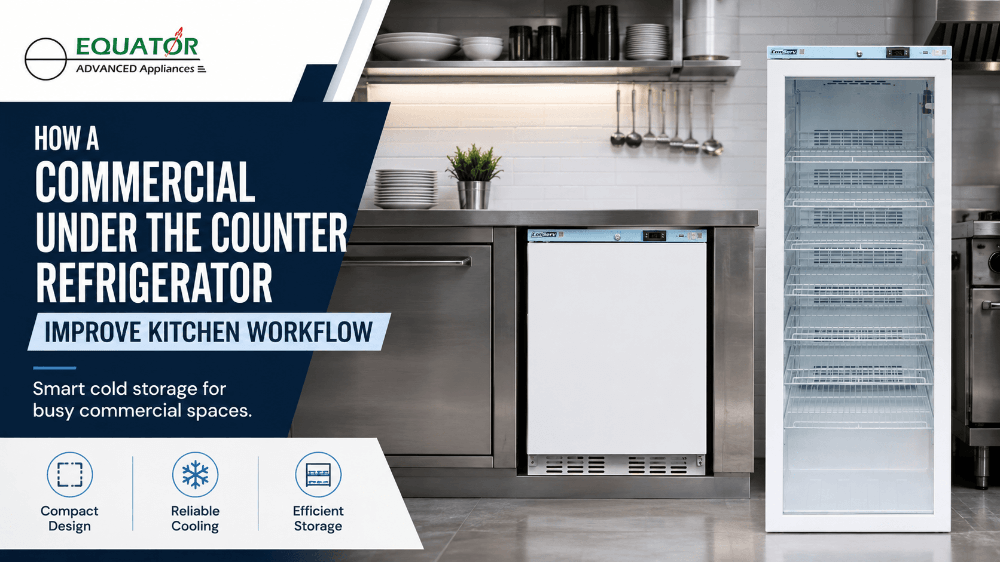
How a Commercial Refrigerator Improves Kitchen Workflow
The most immediate benefit is reduced travel. In a traditional layout, staff may repeatedly cross the kitchen to reach a walk-in cooler or full-height commercial fridge. Those trips look small on paper, but they interrupt prep rhythm, create cross-traffic, and increase the chance of collisions during a lunch rush. An undercounter unit places cold ingredients beneath a prep table, beverage station, service counter, or point-of-use workspace.
For a sandwich station, that might mean storing cheese, sauces, prepared vegetables, and packaged proteins below the cutting surface. At a coffee bar, it could keep milk, cream, cold brew components, and ready-to-serve items near the espresso machine. In a medical or laboratory setting, a compact refrigerator may provide controlled storage close to the staff area, although users should always confirm that the selected appliance, temperature range, monitoring process, and operating procedures meet the requirements for the materials being stored.
Fewer Steps and Cleaner Traffic Patterns
Good kitchen workflow separates receiving, storage, preparation, cooking, plating, and warewashing as much as the space allows. A commercial fridge undercounter supports that sequence by creating a dedicated cold zone at the task location. Employees can open the door, retrieve an item, and return it without walking through another employee’s station.
This is especially useful in galley-style kitchens, food trucks, hotel pantries, concession stands, and compact restaurant backrooms. When one appliance eliminates dozens of unnecessary crossings during a shift, the kitchen feels less chaotic even though its square footage has not changed. The improvement is not glamorous, but neither is repeatedly saying “behind you” while carrying a full tray.
Faster Restocking and Better Station Ownership
An under-the-counter commercial refrigerator also makes it easier to assign responsibility. A bartender can maintain the beverage station, a pastry employee can manage chilled fillings, and a line cook can restock the prep area before service. Clear ownership reduces the chance that ingredients are misplaced or depleted without notice.
For businesses comparing a Commercial Refrigerator with a commercial beverage cooler, the decision should begin with what will be stored and how often it must be accessed. A commercial drinks fridge may prioritize visibility and rapid beverage selection, while a food-prep refrigerator may need shelf flexibility, secure storage, alarms, and a temperature range suited to the operation’s approved food-safety plan.
Why New York, Chicago, and Boston Kitchens Benefit from Undercounter Storage
Urban kitchens often operate in buildings that were not designed for modern commercial equipment. Restaurants in Midtown Manhattan, Williamsburg, Chicago’s West Loop, and Boston’s North End may face narrow doorways, limited service elevators, shallow counters, and tight mechanical spaces. Before buying, operators should measure the full delivery path, not only the final opening. A refrigerator that fits beneath the counter can still become an expensive hallway decoration if it cannot pass through the back door.
Undercounter refrigeration is particularly valuable where rent makes every square foot work overtime. Near Times Square, Seattle’s Pike Place Market, and busy neighborhood cafés, placing refrigeration beneath an existing work surface preserves aisle clearance and keeps wall space available for shelving or taller equipment. The appliance becomes part of the station rather than a separate destination.
Planning Around Older Buildings and Limited Utilities
Many older urban properties have uneven floors, limited receptacle locations, and circuits shared with other equipment. Adjustable feet can help level the appliance, but electrical planning should be reviewed before installation. The product’s voltage, amperage, plug configuration, ventilation needs, and installation instructions must match the site conditions and applicable codes.
Operators should also confirm whether the unit is approved for built-in placement or requires additional clearance. “Undercounter” does not automatically mean “seal it into a cabinet with no airflow.” Follow the manufacturer’s specified clearances and avoid blocking vents, because poor airflow can increase operating stress and reduce cooling performance.
Los Angeles, Houston, and Miami Workflow Challenges
Kitchens in hot climates face a different set of problems. In Los Angeles neighborhoods such as Koreatown, in Houston’s Montrose area, and in Miami’s Wynwood district, high ambient temperatures can add to the heat produced by ovens, dishwashers, grills, and crowded work areas. Frequent door openings during service introduce more warm air, so placement and operating habits become important.
Keep the refrigerator away from direct sunlight, cooking exhaust, and high-heat appliances whenever possible. Do not use the top or ventilation area as an improvised storage shelf if that blocks airflow. In humid or coastal locations, inspect door gaskets, clean surfaces regularly, and watch for condensation around the installation. These routine checks help the unit recover efficiently after repeated openings.
Match Capacity to the Service Cycle
A compact refrigerator works best when its inventory is intentionally limited to the station’s needs. Overloading shelves can restrict air circulation and make products harder to find. Underloading is less harmful to workflow, but buying far more capacity than the station needs may consume valuable space and encourage disorganized storage.
Estimate the amount used between scheduled restocking periods. A café might replenish milk and prepared items twice daily, while a busy bar may need a larger reserve before evening service. The correct capacity is the smallest size that supports the peak period without crowding the interior or forcing constant emergency restocks.
Compact Conserv Options for Point-of-Use Refrigeration
The Conserv Compact 24-inch Commercial/Pharmaceutical Refrigerator offers 3.9 cubic feet of storage in a footprint listed at approximately 35 inches high, 24 inches wide, and 21.2 inches deep. Its specifications include 110V operation, electronic temperature control, three grill shelves, no-frost operation, interior LED lighting, adjustable feet, a door lock, Wi-Fi compatibility, a USB data port, and open-door and high-low temperature alarms. The listed operating range is 35.6°F to 46.4°F, so buyers should verify that this range is appropriate for their intended products and local requirements.
For a prep counter, clinic backroom, café service area, or controlled-access storage station, the compact commercial undercounter refrigerator can place monitored cold storage close to the user without taking over an entire wall. The compact model is listed for freestanding or built-in installation, but the final installation should still follow the owner’s manual, ventilation instructions, and local electrical rules.
Solid-Door and Glass-Door Workflow Differences
A solid door can reduce visual clutter and may suit back-of-house stations where staff already know the shelf layout. A glass door can speed product identification, helping users confirm inventory before opening the unit. That can be useful at a beverage station, clinic, laboratory support area, or organized prep line where quick visual checks matter.
The Conserv compact line includes configurations associated with solid and glass doors. A commercial glass door refrigerator may improve visibility, but it should not become an excuse to ignore labeling. Date marks, shelf zones, and stock rotation remain essential because a transparent door shows what is inside, not whether it is still within an approved holding period.
When the 12.7-Cubic-Foot Model Makes More Sense
The Conserv 24-inch Commercial/Pharmaceutical Refrigerator with 12.7 cubic feet of capacity is a taller alternative for operations that need more storage. Listed features include four grill shelves, electronic controls, 110V operation, Wi-Fi compatibility, USB data logging, a secure door lock, LED lighting, no-frost operation, and temperature and door alarms. Its listed dimensions are approximately 65 inches high, 23.4 inches wide, and 28 inches deep.
This model is not an undercounter appliance, but it can support the same workflow strategy at a larger scale. A restaurant might use the tall unit as the station’s backup inventory while keeping a compact commercial fridge undercounter for immediate service. That two-level system limits trips to the main storage area while preventing the small unit from becoming overpacked.
How to Organize an Undercounter Commercial Fridge
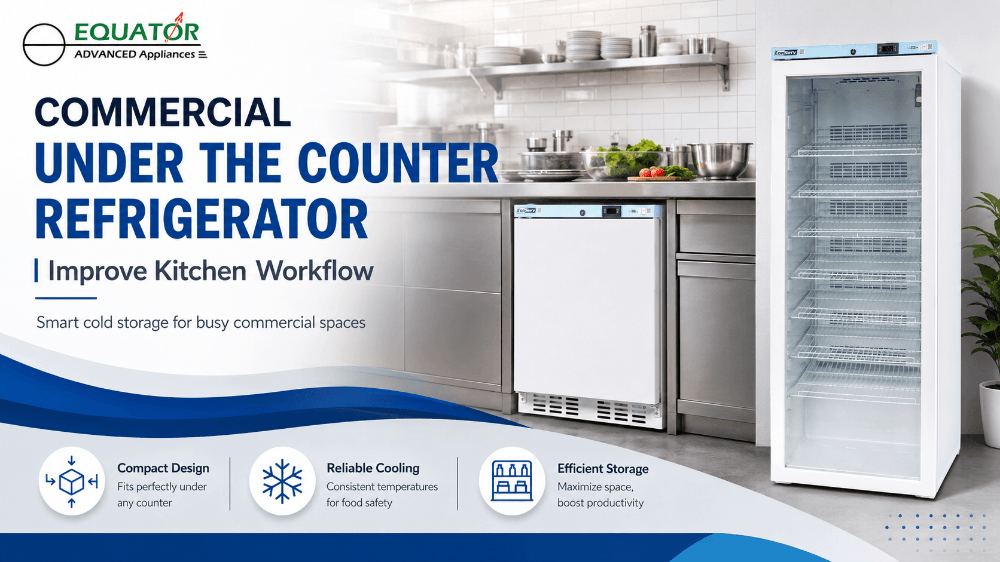
Equipment alone does not create an efficient kitchen. The interior must be organized around the order in which employees work. Frequently used products should be visible and reachable without moving multiple containers, while backup stock should occupy less convenient positions. Each shelf should have a defined purpose that remains consistent across shifts.
- Create station-specific zones. Assign shelves to beverages, dairy, garnishes, prepared ingredients, or approved medical and laboratory materials as applicable. Do not mix incompatible product categories.
- Use clear labels. Identify contents, preparation or receiving dates, responsible staff, and any required discard or review times.
- Follow first-in, first-out rotation. Place newer stock behind older stock so employees use the correct items first.
- Protect airflow. Avoid pressing containers against vents or filling every gap. Cold air must circulate around the stored products.
- Set restocking times. Refill before peak periods rather than waiting until the station runs out during service.
- Record temperature checks. Use the operation’s approved monitoring process and investigate alarm events rather than simply silencing them.
Use Alarms and Monitoring as Workflow Tools
Door and temperature alarms are most valuable when the team knows how to respond. An open-door alert may indicate hurried service, a blocked gasket, poor container placement, or a door that was never fully closed. A high-low temperature alarm requires a documented response, including checking the display, limiting door openings, assessing the stored contents, and contacting qualified service personnel when necessary.
Wi-Fi monitoring and USB data access can support accountability by making operating information easier to review. They do not replace physical inspections, proper loading, thermometer verification where required, or a written response plan. Technology is useful; it is not a tiny manager living inside the refrigerator.
Buying Checklist for a Commercial Refrigerator in Major U.S. Cities
A “commercial refrigerator near me” search may produce many choices, but the nearest seller is not automatically the best fit. Compare the appliance against the actual workflow, building constraints, service availability, and governing requirements. Restaurants, healthcare facilities, laboratories, bars, retail stores, and residential users all have different priorities.
- Measure the opening and delivery route: Include doors, elevators, stairs, corners, trim, casters, and counter overhangs.
- Confirm installation type: Verify whether the model is designed for built-in, freestanding, or both types of placement.
- Check electrical requirements: Match voltage, amperage, grounding, circuit capacity, and receptacle location.
- Review temperature needs: Confirm the listed operating range is suitable for every intended item.
- Evaluate access frequency: Choose solid or glass doors based on visibility, security, and service patterns.
- Plan for cleaning: Leave practical access to the interior, gasket, floor area, and service points.
- Verify support: Review warranty terms, commercial-use coverage, parts availability, and qualified service options in the city.
- Check local rules: Consult the relevant health department, fire authority, building management, and licensed professionals before installation or specialized use.
Residential buyers considering a commercial refrigerator for home use should also evaluate noise, ventilation, appearance, warranty terms, and whether the temperature range suits everyday household storage. A commercial fridge for home can be useful in a large pantry, entertainment room, or serious prep kitchen, but it should be selected for a real functional need rather than the assumption that “commercial” automatically means better for every household.
Frequently Asked Questions About Commercial Undercounter Refrigerators in Major U.S. Cities
What is a commercial under the counter refrigerator?
A commercial under the counter refrigerator is a compact cold-storage appliance designed to fit beneath a work surface or service counter while keeping frequently used items close to the task area. Models vary in capacity, door style, temperature range, monitoring features, ventilation requirements, and approval for built-in installation.
How does an undercounter commercial refrigerator speed up restaurant service?
It shortens the distance between storage and use. Employees can retrieve ingredients, garnishes, beverages, or prepared items without crossing the kitchen, which reduces traffic and keeps each station supplied during busy periods.
Is a commercial beverage refrigerator the same as a food-storage refrigerator?
Not always. A commercial beverage refrigerator or commercial drink cooler may be optimized for bottles, cans, display, and frequent customer-facing access. A food-storage unit may have different shelving, security, alarms, controls, and temperature characteristics. Buyers should select the appliance based on the stored products and applicable requirements, not the label alone.
What size commercial fridge undercounter works for a small café?
The right size depends on the café’s peak inventory between restocking periods. A 3.9-cubic-foot unit can suit a focused station with organized milk, ingredients, or packaged items, while a larger operation may need multiple point-of-use refrigerators or a compact unit backed by a full-height commercial refrigerator.
Can a commercial glass door refrigerator improve inventory control?
Yes, a glass door allows staff to inspect stock levels before opening the refrigerator, which can reduce unnecessary door openings and speed restocking decisions. Inventory control still requires labels, date rotation, shelf assignments, and routine counts.
Can I install a commercial undercounter refrigerator in an older New York or Chicago building?
Possibly, but confirm the delivery path, circuit capacity, receptacle location, ventilation clearance, floor level, building rules, and installation instructions first. Older buildings may have narrow access points and electrical limitations that should be reviewed by qualified professionals.
Is a commercial refrigerator suitable for pharmaceutical storage?
Only when the specific model, operating range, monitoring method, calibration process, power plan, and documented procedures satisfy the requirements for the exact products being stored. A refrigerator marketed for commercial or pharmaceutical environments should not be assumed to meet every vaccine, medication, laboratory, or regulatory standard without verification.
Build a Faster Kitchen Around Point-of-Use Cold Storage
A commercial undercounter refrigerator improves workflow by reducing unnecessary movement, organizing station-level inventory, and keeping essential products close to the employee who uses them. Its value is especially clear in compact urban kitchens, where floor space is expensive and cross-traffic quickly becomes a service problem.
Start with the workflow, then select the capacity, door style, monitoring features, temperature range, and installation type that support it. The Conserv 3.9-cubic-foot compact models can serve focused undercounter stations, while the 12.7-cubic-foot models offer additional capacity for higher-volume operations. Measure carefully, verify local requirements, and design a clear restocking and alarm-response process before the appliance enters service. A well-placed refrigerator should not merely hold products; it should make the entire kitchen easier to run.