


What a Combo Microwave Oven Actually Means for Your Kitchen
The term Combo Microwave Oven covers several different appliance configurations. A conventional combination wall oven and microwave usually places a microwave or speed-cooking unit above a larger wall oven. A compact microwave convection oven combo, on the other hand, combines multiple cooking functions inside one smaller cavity. Understanding that distinction prevents one of the most common buying mistakes: assuming every microwave oven and oven combo fits the same cabinet opening or performs the same jobs.
A microwave and oven combined in one compact appliance can make sense when counter and cabinet space are more important than having a large second oven. These units are particularly useful in apartments, accessory dwelling units, vacation properties, RV-style kitchens, basement kitchens, studios, and secondary cooking areas. A full-size wall oven and microwave combo may make more sense for a household that regularly prepares several large dishes at once and already has cabinetry designed around standard wall appliances.
Do Not Confuse a Compact Hybrid With a Full-Size Wall Oven Combination
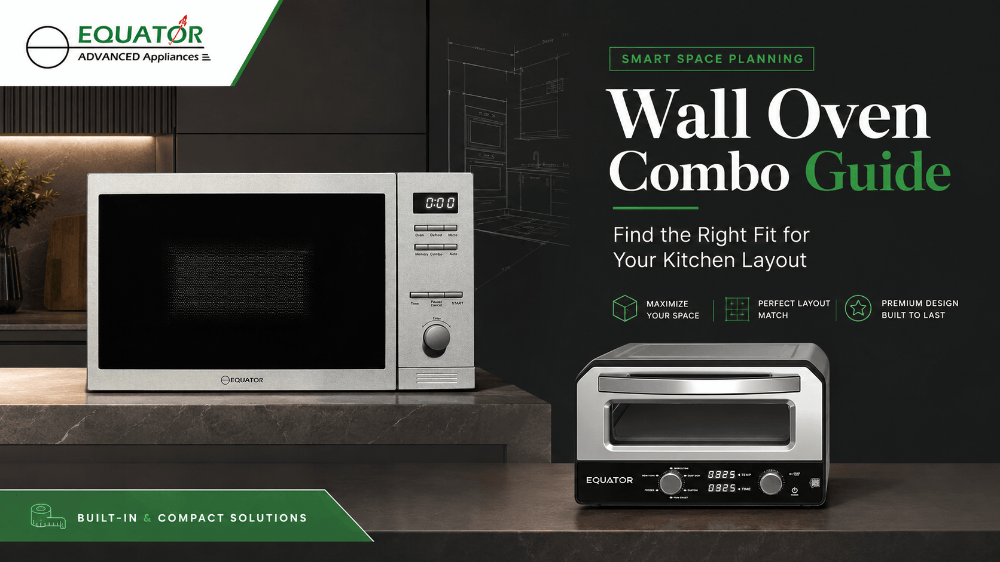
This distinction matters when evaluating the Equator Hybrid Microwave+Oven CMO 800 T. It is a compact 0.8 cu. ft. microwave-and-oven hybrid that can operate freestanding or be incorporated into cabinetry using its included trim kit. Manufacturer specifications list the freestanding dimensions at approximately 11.1 inches high, 18.5 inches wide, and 14.7 inches deep, while dimensions with the trim kit are approximately 14.7 inches high, 23.3 inches wide, and 15.8 inches deep. It operates on 110V, 60Hz, 15A service and includes microwave cooking, auto cook, memory, auto weight defrost, a timer, child lock, and a glass turntable.
That makes the compact microwave convection oven combo particularly interesting for kitchens where a traditional large wall oven combo with microwave would consume too much cabinetry. It is still essential to follow the manufacturer's installation guide instead of treating the trim kit dimensions as the cabinet cutout dimensions. Appliance dimensions, required opening dimensions, ventilation space, and surrounding clearances are related measurements, but they are not automatically interchangeable.
Measure Before Choosing a Wall Oven Combo With Microwave
The cabinet opening should be the starting point for any oven microwave combo wall installation. Measure the width, height, and usable depth of the opening at several points rather than assuming an existing cabinet is perfectly square. Older cabinetry can shift slightly over time, and remodeled openings may contain trim, wiring, framing, outlets, or other obstructions that reduce usable depth.
Record More Than the Visible Cabinet Opening
Before ordering a microwave combination wall oven or compact built-in model, document the following measurements and conditions:
- Opening width: Measure across the top, middle, and bottom.
- Opening height: Check both sides and the center where practical.
- Usable cabinet depth: Account for the rear wall, electrical connections, trim, and manufacturer-required clearances.
- Door clearance: Make sure the open appliance door will not interfere with an island, refrigerator, pantry door, or main walking path.
- Adjacent landing space: Plan a safe nearby surface for hot plates, cookware, and baking dishes.
- Electrical location: Confirm that the required electrical connection can be reached without interfering with installation.
- Ventilation: Follow the installation instructions for the exact appliance rather than enclosing a unit simply because its exterior dimensions fit.
Do not order a wall microwave combo from the nominal size alone. Two appliances marketed for similar spaces can require different cabinet openings, trim arrangements, electrical connections, or ventilation provisions. A quarter-inch surprise during installation has a remarkable talent for becoming an expensive afternoon.
Choosing a Combo Microwave Oven for New York, Chicago, Los Angeles, Houston, and Miami Kitchens
Kitchen layout matters everywhere, but the priorities change considerably among major U.S. cities. In Manhattan neighborhoods such as the Upper West Side, Chelsea, and the East Village, or in Brooklyn and Astoria, Queens, preserving cabinetry and countertop area can be more valuable than installing the largest possible cooking appliance. In a compact kitchen near Central Park, for example, a smaller microwave oven oven combo that integrates neatly into cabinetry may leave more room for pantry storage or meal preparation.
Chicago presents another mix of housing. Condos in the West Loop and Lincoln Park may favor streamlined built-in configurations, while older kitchens in other neighborhoods can require more careful review of cabinet construction and existing electrical infrastructure before a microwave combination wall oven is selected. In apartments and condos around the Loop and Willis Tower, appliance depth and door projection can be just as important as appliance width because circulation space may be limited.
Layout Tips for Los Angeles, Houston, and Miami Homes
Los Angeles kitchens range from compact apartments in Koreatown and Downtown Los Angeles to larger open-plan homes where appliance placement is more flexible. In smaller kitchens, positioning an oven microwave wall unit away from a major traffic path can prevent an open door from becoming an obstacle. In larger kitchens, installation height becomes equally important because the appliance should remain convenient for frequently used microwave functions.
Houston homeowners in areas such as Montrose, The Heights, and the Museum District may have more room to choose between freestanding, built-in, and dedicated wall configurations. Houston's warm climate also makes kitchen heat management worth considering when deciding whether several high-heat appliances should be concentrated in one small area. Adequate manufacturer-specified ventilation around cooking equipment should remain part of the cabinet plan.
Miami high-rises in Brickell and compact homes around Coconut Grove introduce similar space considerations, along with warm, humid conditions that make good kitchen ventilation desirable. Here, a compact combined microwave and conventional oven can help reduce the number of separate appliances occupying valuable surfaces. Regardless of city, however, the correct choice depends more on the actual kitchen measurements and household cooking routine than on ZIP code alone.
Match the Microwave and Oven Combo to the Way You Cook
After confirming fit, decide what jobs the appliance needs to perform. A homeowner who mostly reheats leftovers, defrosts ingredients, and occasionally bakes has different needs from someone who frequently roasts large meals. Avoid paying for features that sound impressive but will rarely be used while overlooking everyday functions that affect convenience.
For Everyday Reheating, Baking, and Compact Cooking
The Equator CMO 800 T combines microwave and oven capabilities in one compact stainless appliance. Its product specifications list an 800W microwave output, a digital control panel, auto-cook functions, memory, auto weight defrost, a child lock, and freestanding or built-in placement with a trim kit. This combination can be practical when the goal is to consolidate routine cooking functions without dedicating a large cabinet section to a conventional stacked wall oven and microwave.
Think of this format as an alternative for space-conscious kitchens rather than an automatic substitute for every traditional wall oven. Capacity still matters. A 0.8 cu. ft. cavity is useful for everyday compact cooking, but households that regularly bake oversized cookware or prepare large holiday meals should compare interior dimensions and cookware compatibility carefully.
When a Dedicated Specialty Oven Makes More Sense
Not every cooking function should necessarily be packed into the microwave and oven combination. Pizza is a good example. Someone who frequently cooks high-temperature pizza may gain more from a dedicated countertop appliance while keeping the microwave oven combo focused on daily reheating, defrosting, warming, and general cooking.
The countertop pizza oven from Equator is designed specifically for that role rather than wall installation. The EPO 500 offers a temperature range from 175°F to 750°F, a 12-inch cordierite pizza stone, six settings covering Neapolitan, Deep Dish, New York, Thin Crust, Frozen, and Custom cooking, dual heating elements, and included pizza accessories. Manufacturer specifications identify it as a 110V, 1500W countertop appliance measuring approximately 16.9 inches high, 17.7 inches wide, and 10.6 inches deep.
This illustrates an important planning principle: the right kitchen does not always need one appliance that does absolutely everything. Sometimes a compact microwave and oven combo for daily cooking plus a specialized countertop appliance produces a more useful workflow than sacrificing extensive cabinetry for a much larger combination unit.
Plan Electrical, Ventilation, and Installation Requirements Early
Electrical requirements should be verified before cabinetry is ordered or altered. Never assume that a compact combi microwave oven and a traditional full-size wall oven microwave combo use the same electrical service. Check the installation manual and appliance rating information for the exact model, then have electrical work reviewed or performed by a qualified professional where required.
The CMO 800 T, for example, is specified for 110V, 60Hz, 15A electrical service. That specification is one reason it may suit certain compact renovations differently from a larger conventional wall oven system. The important point is not to generalize that requirement to other combination ovens; every model should be checked individually.
Ventilation and Cabinet Integration Matter Too
A stainless trim kit can create a polished built-in appearance, but decorative trim is not permission to block required airflow. Use only the installation arrangement approved for the appliance and maintain all manufacturer-required clearances. Do not improvise a built-in enclosure around an appliance designed only for countertop use.
This is particularly relevant when comparing the two Equator products discussed here. The CMO 800 T is specifically presented with freestanding and built-in options and includes a trim kit, while the EPO 500 pizza oven is specified as a countertop appliance. Treating them as interchangeable installation types would ignore an important product distinction.
Common Wall Microwave Combo Mistakes in U.S. Kitchen Remodels
Many disappointing appliance purchases are not caused by poor cooking performance. They happen because the appliance does not work naturally with the room. Before committing to an oven microwave oven combination, watch for these planning mistakes:
- Buying by exterior width alone. Cabinet opening, trim, depth, ventilation, and electrical requirements all matter.
- Installing the appliance too high. Frequently used microwave controls and hot containers should remain comfortable to reach for the people who use the kitchen.
- Ignoring the open door. A microwave over oven combo that looks perfect when closed can obstruct a narrow galley kitchen once its door is open.
- Eliminating nearby counter space. Users need a convenient location to place hot dishes after removing them.
- Assuming every “combo” provides full-size oven capacity. Compact hybrids and traditional combination wall ovens serve different needs.
- Using a countertop-only appliance as a built-in. Installation classifications and ventilation instructions should always be respected.
- Choosing features before defining cooking habits. Start with what the household cooks weekly, then select the functions that support those meals.
A strong appliance decision is ultimately about usefulness, not the number of specifications that can fit on a product page. Accurate product information, clearly defined use cases, and attention to installation limitations help homeowners make a more informed purchase.
Frequently Asked Questions About Combo Microwave Oven Options in Major U.S. Cities
What is the difference between a combo microwave oven and a wall oven microwave combo?
A combo microwave oven can refer broadly to an appliance that combines microwave cooking with oven-style cooking functions. A wall oven microwave combo usually refers to a larger built-in configuration in which microwave and oven components are installed together vertically. Compact hybrid models can provide several cooking methods without requiring the cabinet space of a full-size combination wall unit.
Can a microwave and oven combo be installed in any kitchen cabinet?
No. An appliance should be installed in cabinetry only when the manufacturer approves a built-in configuration and the cabinet opening, clearances, ventilation, electrical service, and trim requirements are satisfied. A countertop appliance should not be converted into a built-in merely because its exterior dimensions fit inside an opening.
Is a compact wall microwave combo good for a New York apartment?
It can be, particularly when cabinet and counter space are limited. Kitchens in Manhattan, Brooklyn, and Queens often benefit from appliances that consolidate functions, but buyers should still measure the cabinet carefully and confirm that door clearance, ventilation, and electrical access work with the selected model.
What should Chicago condo owners check before installing an oven microwave combo wall unit?
Start with cabinet dimensions and the appliance installation specifications, then verify electrical requirements and surrounding clearances. In an older condo or remodeled kitchen, it is especially important not to assume that an existing opening or electrical connection automatically matches a newer appliance.
Is a combination microwave toaster oven the same as a microwave convection oven combo?
Not necessarily. Searches for a microwave toaster oven combo can lead to countertop appliances that emphasize toasting, browning, or air-fry-style functions, while a microwave convection oven combo generally combines microwave energy with oven or convection-style heat. Compare the actual cooking modes instead of relying on the category name alone.
What size microwave oven and oven combo should I buy for a small kitchen?
Choose based on both exterior fit and usable interior capacity. First determine the maximum cabinet or countertop footprint your layout can accommodate, then confirm that your everyday plates, cookware, and baking dishes fit the cooking cavity. Going smaller saves space only when the appliance can still handle the meals you regularly prepare.
Can I use a pizza oven instead of a microwave combination wall oven?
Usually not if you need microwave functions. A dedicated pizza oven is optimized for high-temperature baking, while a microwave and oven combo is designed for broader everyday tasks such as reheating, defrosting, and oven-style cooking. For households that frequently make pizza, the two appliance types can complement one another rather than compete for the same role.
Choose the Wall Oven Combo With Microwave Around Your Layout, Not Around a Feature List
The right wall oven combo with microwave begins with a tape measure and a realistic look at how the kitchen is used. Compare cabinet dimensions, door clearance, nearby work surfaces, interior capacity, installation classification, electrical requirements, ventilation, and the cooking functions your household actually needs. A compact hybrid such as the Equator CMO 800 T may be particularly attractive where homeowners want microwave and oven functionality with flexible freestanding or built-in placement, while a dedicated countertop pizza oven can add specialized high-temperature cooking without requiring another wall installation.
From compact apartments in Manhattan and Chicago to open-plan homes in Houston, Los Angeles, and Miami, there is no single microwave oven combo wall configuration that is right for every kitchen. Measure first, compare the manufacturer's installation requirements carefully, and choose an appliance whose capacity and cooking methods fit your normal routine. The result should be more than an appliance that technically fits the opening—it should make the entire kitchen easier to use.